




Inhibitory effect of Female sex hormone on the THIK-1 channel
2026.08.06
Research
概要
A research team has revealed that THIK-1, a two-pore domain K+ (K2P) channel expressed in immune cells, including brain microglia and systemic macrophages, is inhibited by a steroid 17β-estradiol, a key female sex hormone. The researchers also found that a human THIK-1 genetic variant is sensitive to the hormone at low, naturally occurring physiological concentrations, showing a 12% reduction in activity.
研究成果
THIK-1, a two-pore domain K+ (K2P) channel, plays important roles in microglia and macrophages. While previous reports have indicated that steroids, including cholesterol, estradiol, and progesterone, modulate several K+ channels, the effect of steroids on THIK-1 channels remained unknown. Working under the hypothesis that steroids might regulate THIK-1 channel function, the research group investigated this possibility.
In this study, researchers demonstrated that 17β-estradiol (10 μM) —a key female sex hormone—inhibits mouse THIK-1 by approximately 40%. Using docking simulations and target mutagenesis, the team identified possible estradiol-binding sites in THIK-1, which were subsequently tested by introducing alanine substitutions at residues located within or near these sites. The F142A, V269A, and Y273A mutations reduced estradiol-mediated inhibition. These residues lie in the upper cavity above the Y-gate of THIK-1, named as the pond, suggesting that the conformation of this region is critical for inhibition by estradiol.
Furthermore, when evaluating a human THIK-1 variant, the researchers observed that it was inhibited even at a low, physiological concentration of estradiol (10 nM).
In summary, the researchers revealed that estradiol-mediated inhibition of THIK-1 depends on residues in the pond region and may have physiological or pathological relevance for THIK-1 variants.
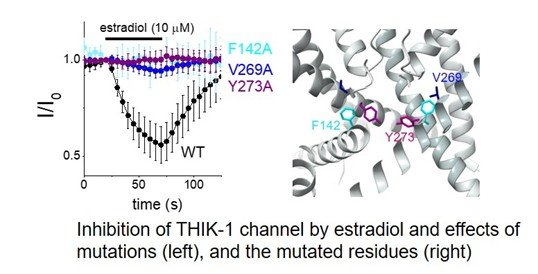
In this study, researchers demonstrated that 17β-estradiol (10 μM) —a key female sex hormone—inhibits mouse THIK-1 by approximately 40%. Using docking simulations and target mutagenesis, the team identified possible estradiol-binding sites in THIK-1, which were subsequently tested by introducing alanine substitutions at residues located within or near these sites. The F142A, V269A, and Y273A mutations reduced estradiol-mediated inhibition. These residues lie in the upper cavity above the Y-gate of THIK-1, named as the pond, suggesting that the conformation of this region is critical for inhibition by estradiol.
Furthermore, when evaluating a human THIK-1 variant, the researchers observed that it was inhibited even at a low, physiological concentration of estradiol (10 nM).
In summary, the researchers revealed that estradiol-mediated inhibition of THIK-1 depends on residues in the pond region and may have physiological or pathological relevance for THIK-1 variants.
科研費や補助金、助成金など
Grants-in-Aid (C) 21K06793 (to M.T.), from the Japan Society for the Promotion of Science.
論文情報
Title: Inhibitory effect of 17β-estradiol on the THIK-1 channel
Authors: Michihiro Tateyama, Yoshihiro Kubo
Journal: PLOS ONE
Date: July 17, 2026
URL: https://journals.plos.org/plosone/article?id=10.1371/journal.pone.0353757
DOI: 10.1371/journal.pone.0353757
Authors: Michihiro Tateyama, Yoshihiro Kubo
Journal: PLOS ONE
Date: July 17, 2026
URL: https://journals.plos.org/plosone/article?id=10.1371/journal.pone.0353757
DOI: 10.1371/journal.pone.0353757