




AMP kinase, a therapeutic drug target for obesity and diabetes, regulates mitochondria and energy metabolism-related gene expressions in skeletal muscle cells
The prevalence of obesity and type 2 diabetes is increasing dramatically in all of the world. The increase in obesity and diabetes is partly due to the muscle atrophy induced by aging and decrease of exercise and resultant suppression of glucose and lipid utilization in skeletal muscle. AMP kinase (AMP-activated protein kinase) regulates the gene-expressions for mitochondrial biogenesis, energy metabolism and autophagy as well as glucose, lipid and protein metabolism. AMP kinase is also necessary for feeding and metabolic regulation by hormones such as leptin and adiponectin and also carbohydrate preference. Furthermore, AMP kinase is a target of anti-diabetic drug metformin. Thus, these results suggest that AMP kinase is one of the therapeutic drug-targets for obesity and diabetes.
AMP kinase is composed of α, β and γ subunits. The α subunit, which has a catalytic domain, contains α1 and α2. AMP kinases containing α1 and α2 (AMPKα1 and AMPKα2) have been believed to regulate distinct cellular functions because expressions of α1 and α2 are different in tissues, cells and developmental stages. However, the role of AMPKα1 and AMPKα2 remains unknown.
In the present study, we explored the role of AMPKα1 and AMPKα2 in gene expressions and metabolism in skeletal muscle cells. We made C2C12 cell lines stably expressing a scramble short hairpin RNA (shRNA) or shRNAs specific for α1, α2, or both α1 and α2. The results showed that AMPKα2 preferentially regulates gene expressions for mitochondrial biogenesis, energy metabolism and muscle hypertrophy including PGC (peroxisome proliferator-activated receptor gamma coactivator)-1α1, PGC-1α4 and muscle creatine kinase in differentiated skeletal muscle cells, thereby increasing the number of mitochondria and muscle cell size. Furthermore, activated AMPKα2 was found to increase gene expression of PGC-1α1 through the nuclear translocation of this enzyme.
AMP kinase is a therapeutic drug target for obesity and diabetes. However, activation of all type of AMP kinases may induce unexpected side effects in patients, because AMP kinases have multiple functions. The present study showed that AMPKα2 preferentially regulates gene expressions for mitochondrial biogenesis, energy metabolism and muscle hypertrophy in skeletal muscle cells. Thus, AMPKα2 may be a specific therapeutic drug-target for obesity and diabetes.
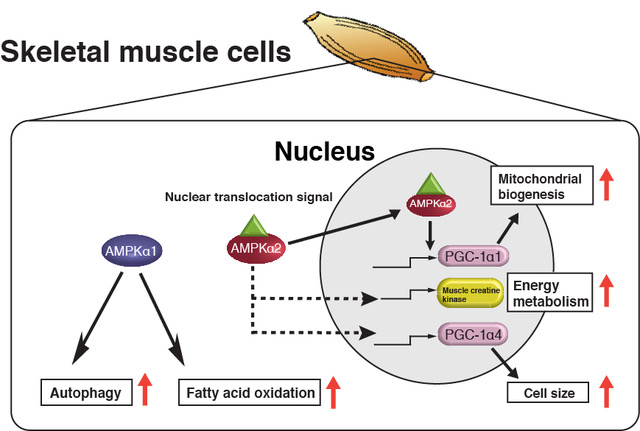
Regulatory role of AMP kinase in mitochondria and energy metabolism-related gene expressions in skeletal muscle cells.
Copylight: Minokoshi and NIPS
Collaborative Researcher
Name: Shiki Okamoto
Department: Division of Endocrinology and Metabolism, Department of Homeostatic Regulation
Institute: National Institute for Physiological Sciences
Present address
Department: Second Department of Internal Medicine (Endocrinology, Diabetes and Metabolism, Hematology, Rheumatology), Graduate School of Medicine
Institute: University of the Ryukyus
Name: Nur Farehan Asgar
Department: Division of Endocrinology and Metabolism, Department of Homeostatic Regulation
Institute: National Institute for Physiological Sciences
Name: Name: Shigefumi Yokota
Department: Division of Endocrinology and Metabolism, Department of Homeostatic Regulation
Institute: National Institute for Physiological Sciences
Funding
A Grant-in-Aid for Scientific Research (B) and a Grant-in-Aid for Scientific Research on Innovative Areas (to Y. Minokoshi), and a Grant-in-Aid for Scientific Research (C) (to S. Okamoto) from the Japan Society for the Promotion of Science.