3976
Member
Introduction of the Section of International Collaborative Research Project
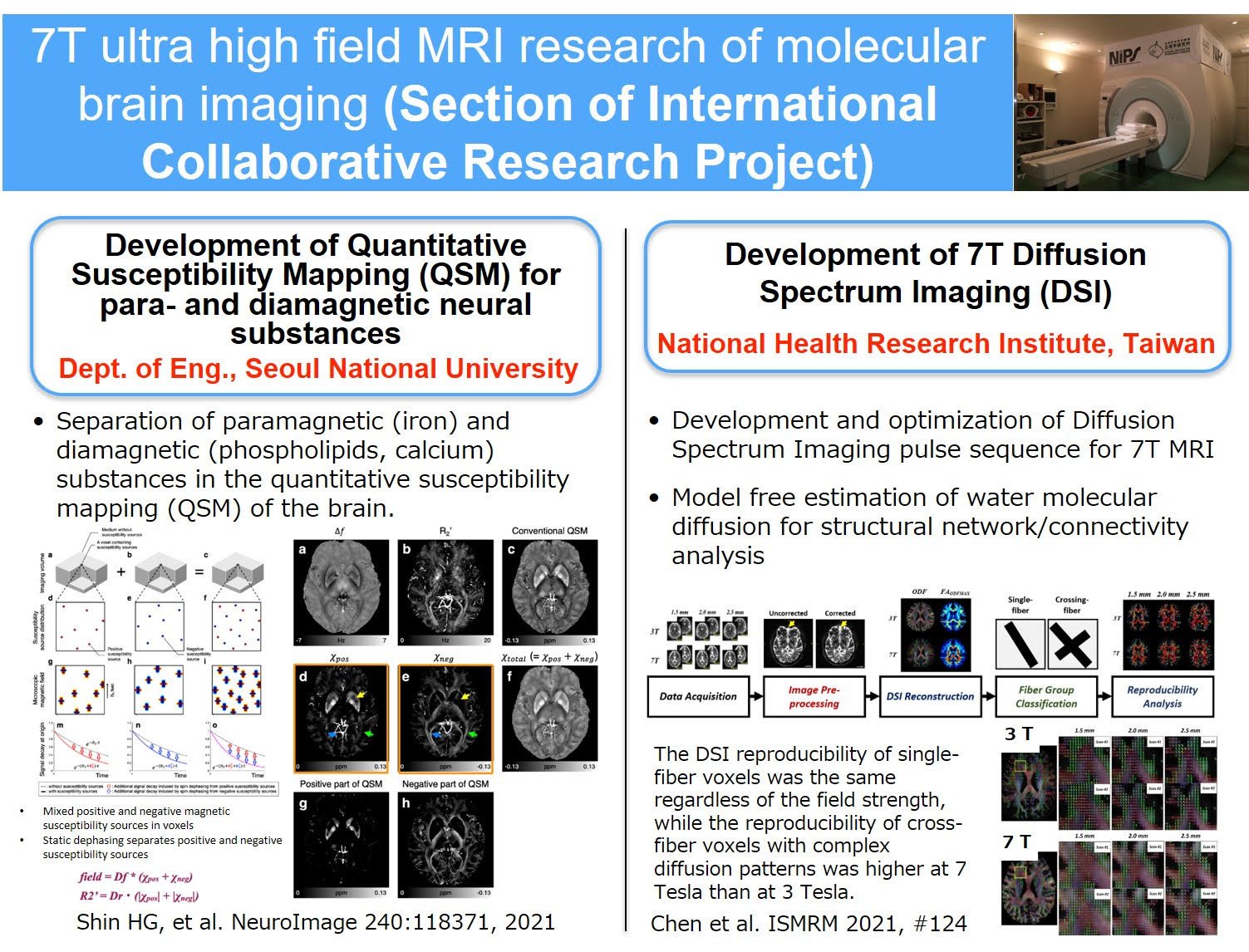
In FY2014, NIPS established the Section of International Collaborative Research Project. In FY2017, NIPS invited Dr. Denis Le Bihan to join as a Principal Investigator (P.I.) of the section. He is a leading authority on Magnetic Resonance Imaging (MRI) and is well-known as an inventor of the revolutionary imaging method called diffusion-weighted imaging. Dr. Le Bihan was also a founding director of NeuroSpin, which belongs to the Life Science Bureau, a basic research division of France's Commissariat à l'énergie atomique et aux énergies alternatives (CEA). The institute conducts brain research using MRI at a very high level of technological sophistication and is also leading the development of the world's highest-performance MRI instrument, the Human-oriented 11.7 Tesla Device. Dr Le Bihan served as P.I. of the Section of International Collaborative Research Project in NIPS for 6 years till FY2022, and engaged in research on the development of imaging technology using 7Tesla-MRI and its application to brain science, in collaboration with the Division of Cerebral Integration in NIPS (Professor Norihiro Sadato). Two international projects with Seoul National University (South Korea) and National Health Research Institutes (Taipei) were also performed (Fig. 1).
In FY2024, under an MOU with the University of New South Wales (Sydney, Australia), we invited Dr. Andrew Moorhouse -who transitioned to the University of Sydney in February 2025- as a Visiting Foreign Researcher. He has made outstanding achievements in research on understanding microglia for the brain functions at the circuit level. In collaboration with the Division of Multicellular Circuit Dynamics (Professor Hiroaki Wake), we continued to invite him in 2025 for further joint research. These collaborations make a significant contribution to enhance the international literacy and global engagement of our young researchers.
In FY2026, we will invite two new foreign visiting professors to further strengthen international collaborative research. In addition, by appointing Visiting Professor Ken-ichiro Tsutsui, we will launch new initiatives to promote international collaboration through FAONS (the Federation of Asian-Oceanian Neuroscience Societies) and other frameworks.