Member
Development of Measurement Methods Using Magnetic Resonance Technology and Research on Biological Structure-Function Relationships
Magnetic resonance (MR) is an excellent technology that allows us to noninvasively observe the structure, function, metabolism, and molecular dynamics of living systems. At the Section of Brain Function Information, Supportive Center for Brain Research, we conduct a wide range of research, from basic MR studies and protocol development to clinical image analysis. Our section works to develop foundational technologies—such as refining measurement and analysis protocols and validating safety—while also supporting brain and whole-body imaging for humans, non-human primates, and rodents through collaborative programs. By using high-field MRI systems (3 Tesla, 7 Tesla, and 11.7 Tesla for small animals), we seek to understand the structure-function relationships of the nervous system and develop new ways to measure biological parameters. We also work to understand diseases through brain imaging by identifying endophenotypes and biomarkers of psychiatric disorders using large-scale data from multi-center clinical collaborations. In addition to developing mathematical and statistical methods to process these data, we are also committed to fostering researchers who can master high-field MRI for their scientific inquiries.
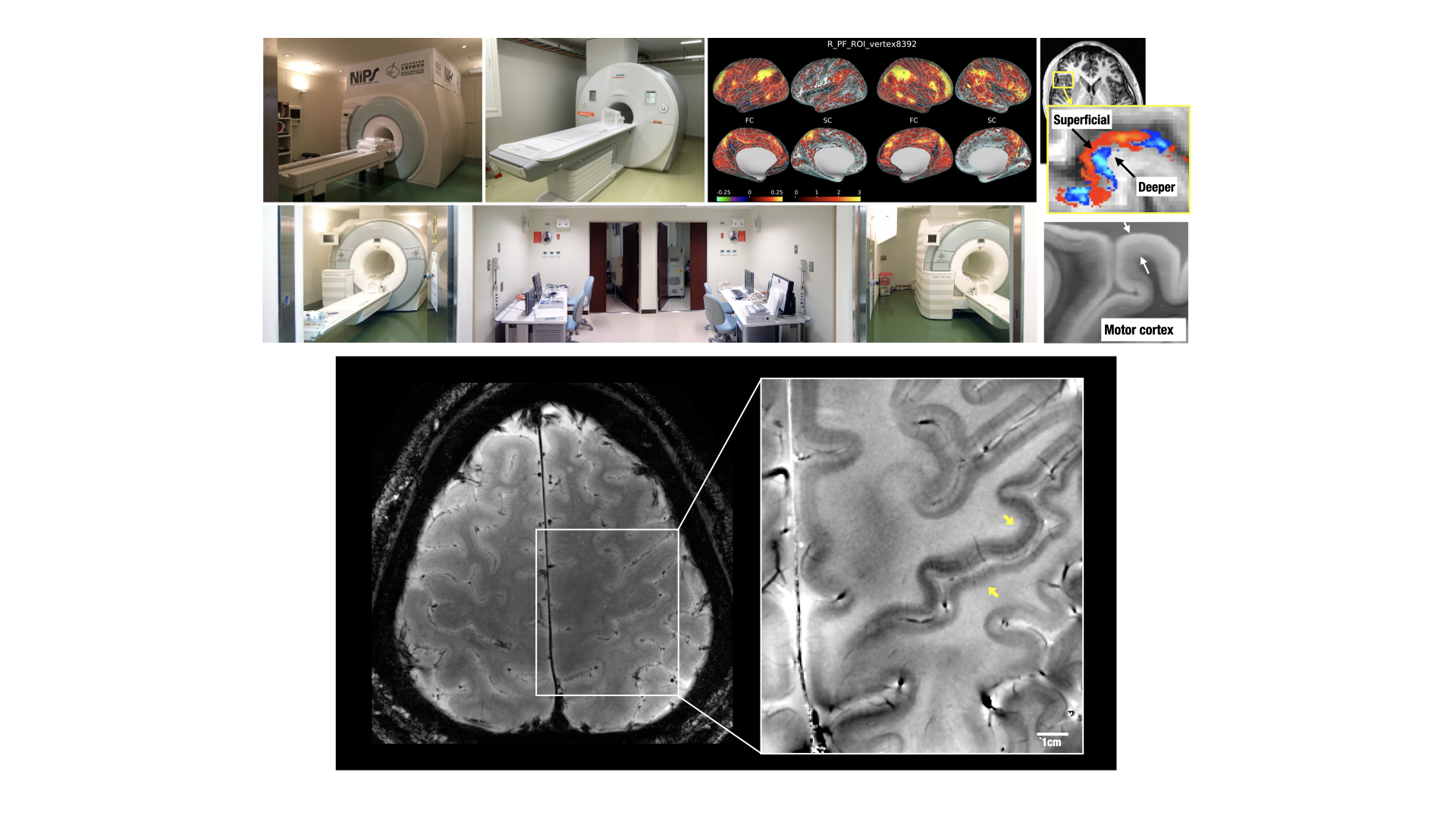
MRI systems operated by the National Institute for Physiological Sciences (7-tesla ultra-high field MRI: Siemens Magnetom 7T, 3-tesla high-performance gradient MRI: Siemens Magnetom Cima.X, 11.7-tesla preclinical MRI: Bruker Biospec 117/16). Functional (FC) and structural (SC) brain connectivity mapping by functional MRI (fMRI) and diffusion MRI (dMRI). Layer-fMRI for cortical laminar resolution obtained by 7T MRI. MR microscopy using 11.7 T MRI
Selected publications
*Yamamoto T, Miura K, Matsuda K et al. Brain-wide activation and deactivation maps during smooth and saccadic tracking in humans Cerebral Cortex 35, bhaf242 (2025)
*Schijven D, Postema MC, Fukunaga M et al. Large-scale analysis of structural brain asymmetries in schizophrenia via the ENIGMA consortium. Proc Natl Acad Sci U S A. 120, e2213880120 (2023)
*Goda N, Hasegawa T, Koketsu D et al., Cerebro-cerebellar interactions in nonhuman primates examined by optogenetic functional magnetic resonance imaging. Cereb Cortex Commun 3, tgac022 (2022)
*Maruyama S, Fukunaga M, Sugawara SK et al., Cognitive control affects motor learning through local variations in GABA within the primary motor cortex. Sci Rep 11, 18566 (2021)
*Yamamoto T, Fukunaga M, Sugawara SK et al., Quantitative Evaluations of Geometrical Distortion Corrections in Cortical Surface‐based Analysis of High‐resolution Functional Mri Data at 7T. J Magn Reson Imaging. 53, 1220 (2021)