Our department leverages cutting-edge technologies in fields such as laser optics and material chemistry to drive the development of innovative bio-imaging methods and their applications in basic medicine. We lead the global research community in non-invasive imaging and manipulation techniques—specifically focusing on multiphoton excitation and nonlinear optical processes—to achieve broader, higher-resolution, and ultra-high-speed observations within living organisms and tissues. Through the quantitative visualization of physiological functions, our goal is to elucidate the emergent principles and molecular foundations of life processes, ranging from neural circuits and exocytosis to hibernation and circadian rhythms.
A hallmark of our recent achievements is the development of a multiphoton microscope capable of the world’s deepest biological tomographic fluorescence imaging, utilizing near-infrared ultrashort pulsed lasers and adaptive optics. We have successfully achieved not only tomographic imaging of the hippocampal dentate gyrus at a depth of approximately 1.6 mm in the living mouse brain but also video-rate observation of CA1 neuronal activity. Furthermore, by utilizing long-term cellular imaging techniques, we are advancing research into the generation and function of 24-hour circadian rhythms in mammals. In addition, we have recently embarked on a new research program focused on the physiological functions and molecular foundations of hibernation, through which we are already gaining novel insights.
In parallel, we are pushing the boundaries of super-resolution microscopy, enabling the imaging of minute structures and molecular dynamics in living cells with a resolution approaching that of electron microscopy. These high-speed 3D imaging technologies are being applied to uncover the emergent principles of local neural circuit functions, the physiological mechanisms of endocrine, exocrine, and plant cells, and the molecular pathways underlying disease onset.
Our department actively fosters collaborative research, bridging diverse disciplines including life sciences, applied physics, material chemistry, basic medicine, and pharmacy. By weaving together the “advancement of imaging technology” and “cellular physiology” as our warp and woof, we aim to create a new interdisciplinary field that captures biological phenomena exactly as they occur in nature. We welcome graduate students and early-career researchers who are passionate about pioneering new frontiers in science.
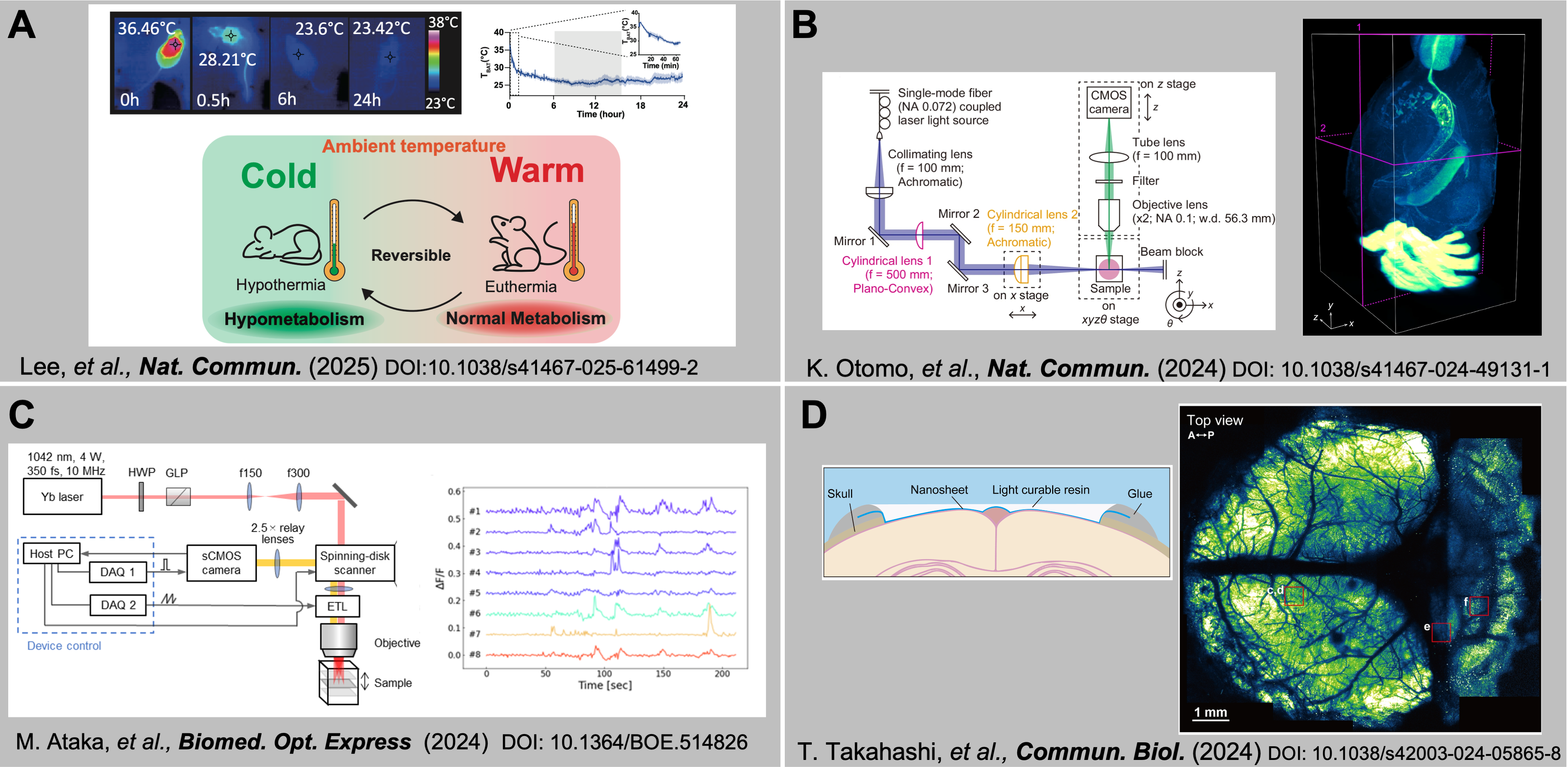
Fig.
(A) Body temperature reversibly regulates glucose metabolism (B) Whole-brain fluorescence imaging of mouse using novel light-sheet microscopy. (C) High-speed volumetric imaging with an electronically tunable lens. (D) Ultra-widefield observation using novel optical materials.