Electrophysiological techniques are useful for studying the functional properties of cells, tissues, and organs (such as the brain and heart) with high temporal resolution. This section aims to elucidate the principles of synaptic transmission, its regulation, the functional architecture of neural circuits, and their dynamic control mechanisms, primarily through electrophysiological approaches. In addition, we provide consultation and technical support for electrophysiological experiments, promote collaborative and commissioned research, and contribute broadly to the understanding of biological phenomena. Ongoing projects are listed below.
1) Neuronal information processing at the tripartite synapse
Based on the concept of the tripartite (three-part) synapse—comprising presynaptic and postsynaptic neurons and surrounding glial processes—we investigate molecular and cellular mechanisms of neuronal processing, focusing on neurotransmitter transporters. In collaborative projects, we analyze genetically engineered animal models to elucidate disease mechanisms and develop potential therapies for neurological disorders such as rapid-onset dystonia with parkinsonism (RDP), familial hemiplegic migraine (FHM), and bipolar disorder. In addition to fundamental techniques like electrophysiology, histology, and pharmacology, we employ advanced approaches, including light-activated compounds.
2) Regulation of neural network activity for motor learning
Neurons form complex networks between them and send information to multiple brain areas. We are investigating how neural network activity related motor learning is regulated in the cortex and the basal ganglia system (Fig. 1). We approach these questions using electrophysiology, computer simulation, and behavior analysis. We also analyze how neurotransmitters including dopamine regulate intrinsic membrane properties of cells and reward related behaviors as a research collaboration.
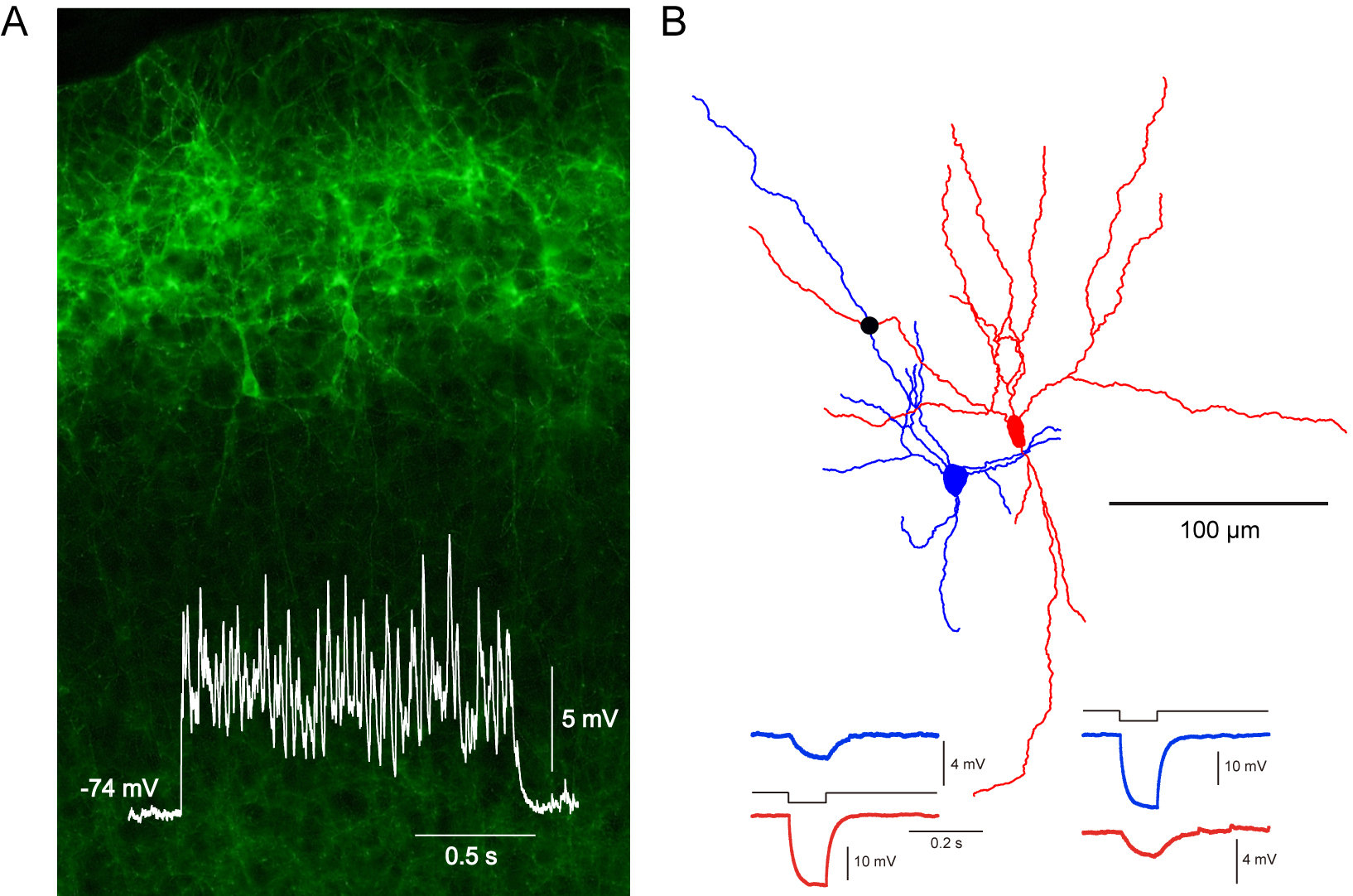
Fig.
(A) Network activity evoked by optogenetic stimulation. ChR2-Venus was selectively expressed in cortical L2/3 pyramidal cells. During light stimulation, membrane potential oscillation was induced in L5 pyramidal cell.
(B) Reconstruction of cortical FS interneurons. Electrically connected FS cells, confirmed by negative current injection to one of two cells, were simultaneously recorded. ● indicates electrical connection site.