|
Researchers have discovered ion channel molecules that respond directly to extracellular potassium, revealing a similar potassium-binding mechanism in fruit flies and humans. This discovery may point to previously unexplored mechanisms for sensing extracellular K⁺ and its homeostasis, potentially leading to new therapeutic targets. |
Researchers from the National Institute for Physiological Sciences, Nagoya City University, and Tokyo Metropolitan Institute of Medical Science in Japan have identified the first animal ion channel molecules that open and close in response to extracellular potassium ions (K+).
Okazaki, Japan, 22 April 2026 – Potassium ions (K⁺) are essential for all cells and living organisms. Scientists have long believed that K⁺ merely passes through ion channels and transporters, rather than acting as an extracellular ligand or molecular “switch.” Indeed, there had been no clear evidence that K⁺ functions as a ligand for membrane proteins in animals or plants—until now.
“Unexpectedly, we made this discovery serendipitously while testing the effect of aspartic acid, with K⁺ added as a counter cation, on Alka, an ion channel located in the brain of Drosophila melanogaster,” said Shimomura. “The compound was effective. At first, we thought the effect was due to aspartic acid, but we ultimately realized that it was caused by K⁺, meaning that Alka functions as a membrane receptor that detects extracellular K⁺ as a ligand.”
Ion channel currents in Alka-expressing cells changed significantly in response to K⁺ levels. The researchers combined electrophysiological analysis with AlphaFold3, an AI-based protein structure prediction tool. This allowed them to identify the K⁺-binding site in Alka. This site creates a chemical environment favorable for K⁺, similar to that found in aqueous solution or in the well-known selectivity filter of K⁺ channels.
Based on these findings in fruit flies, the researchers next investigated whether K⁺ functions similarly in humans by examining the glycine receptor (GlyR), an ion channel related to Alka that is expressed in the human brain. Although changes in extracellular K⁺ concentration did not affect the conventional form of GlyR, they did modulate an RNA-edited form of GlyR, despite its low efficacy. This suggests that K⁺ may also act as a molecular “switch” in humans.
“The K+ binding in GlyR is likely too weak to function under healthy conditions in the human brain, where extracellular K⁺ concentration is maintained within a narrow range of 3–5 mM,” said Suzuki. “However, these levels can rise abnormally during epileptic episodes. Because the RNA-edited form of GlyR is abundant in the brains of patients with temporal lobe epilepsy, changes in this receptor may represent a mechanism for responding to pathological K⁺ fluctuations.”
This study reveals a novel “switch-type” sensor for extracellular K⁺ levels, complementing the well-known “permeation-type” mechanism. The discovery may help uncover new mechanisms governing extracellular K⁺ homeostasis, clarify links to diseases such as epilepsy, and support the development of therapeutic drugs targeting these K⁺-dependent channels.
###
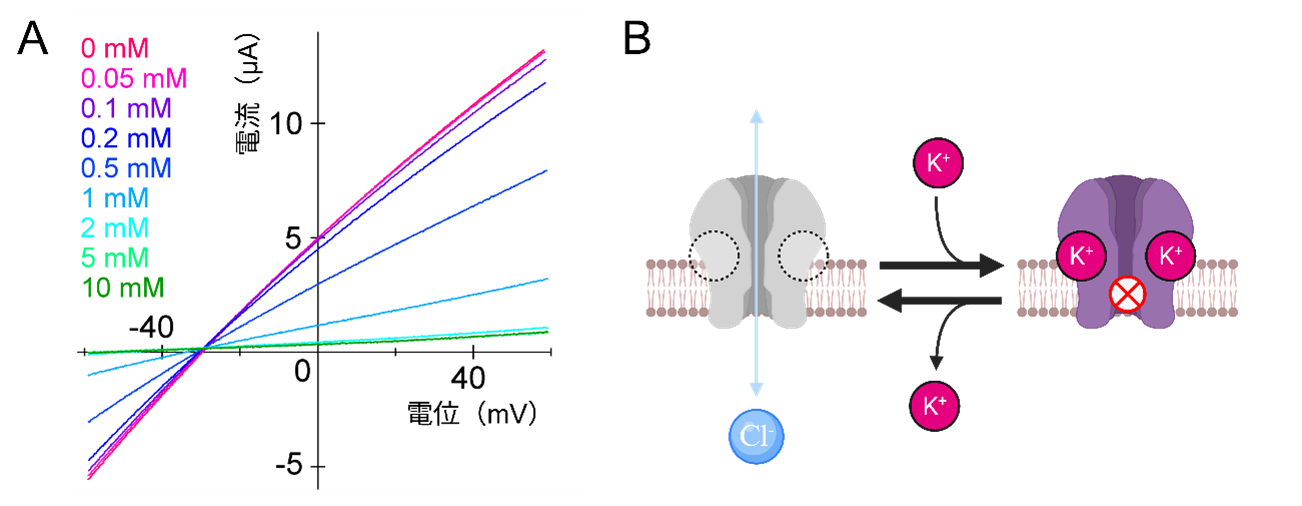
Increase in the extracellular K⁺ concentration decreases the electric currents passing through the Alka channel (A), indicating that K⁺ binding induces a state transition to the closed state in Alka
(B).
552